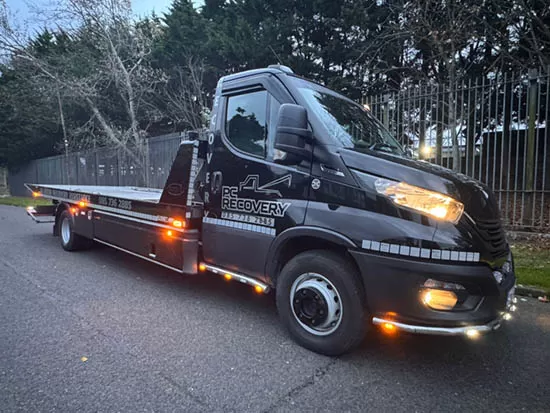
Flatbed Towing Explained
Flatbed towing uses a truck with a flat, hydraulic platform — the "bed" — that tilts down to road level to allow a vehicle to be loaded onto it. Once the vehicle is on the flatbed, it's secured with straps before the platform returns to horizontal for transport.
The key feature of flatbed towing is that all four of the towed vehicle's wheels come completely off the ground. The vehicle sits on the platform rather than being dragged or rolled behind the tow truck.
How Is Flatbed Different from Other Towing Methods?
There are three main types of vehicle towing:
1. Flatbed Towing
The vehicle is loaded fully onto a flat platform. All four wheels are off the ground. This is the safest and most protective method for the towed vehicle — there is no stress on the drivetrain, no wheel rotation, and no risk of the tow line causing damage to the front or rear of the car.
2. Wheel-Lift Towing
A metal yoke hooks under the front or rear wheels and lifts that end of the car off the ground, leaving the other two wheels rolling on the road. This puts mileage on the rolling tyres and can cause suspension and drivetrain wear, particularly on four-wheel-drive vehicles.
3. Hook-and-Chain Towing
An older method where chains attach around the vehicle's axle and drag it. This can cause bodywork damage and is rarely used today by professional operators.
Why Flatbed Is the Safest Choice
Flatbed towing is recommended for most vehicles because:
- Zero drivetrain risk: No wheels turning means no odometer mileage added and no torque through the gearbox or differential
- Safe for AWD and 4WD: All-wheel-drive and four-wheel-drive vehicles should not be wheel-lifted — flatbed is the required method for these
- Safe for automatics: Automatic transmissions can be damaged when towed with wheels rolling without the engine running
- Low-clearance vehicles: Sports cars and low-profile vehicles can be loaded carefully onto a flatbed without grounding
- Non-runners: If your car won't start or move under its own power, a flatbed is the only practical option
Dublin Tow Uses Flatbed for Every Job
Dublin Tow uses flatbed trucks for all towing and recovery jobs across Dublin. This isn't just about safety — it's about protecting your vehicle. Whether you're moving a standard family car or a sports car, a van or a non-runner, your vehicle will arrive at its destination in exactly the same condition as when we picked it up.
Need flatbed towing in Dublin? Call Dublin Tow — 24/7 across all of Dublin.
Call 085 820 8677Flatbed Towing — Common Questions
No — because all four wheels come off the ground, the wheels don't rotate during transport and the odometer doesn't change. This is one of the key advantages of flatbed over wheel-lift towing.
Yes — in fact, flatbed is the only recommended method for AWD and 4WD vehicles. Wheel-lift towing an all-wheel-drive vehicle can cause serious and expensive drivetrain damage. Always ask for a flatbed if you drive an AWD or 4WD.
Yes — Dublin Tow's flatbed trucks operate 24 hours a day, every day of the year. Call 085 820 8677 at any time and we'll be with you in around 30 minutes.